
Assessment - Key Stage 3
Key Stage 3 Reporting and Assessment
Students receive Progress Checks at several points throughout the academic year. These provide information on:
- Academic attainment
- Effort
- Homework
- Behaviour
- Attendance
Up-to-date information on attendance and behaviour is also available via the Arbor Parent Portal and Arbor Parent App.
A student’s effort, behaviour, and completion of homework have a direct impact on their attainment. Students are therefore expected to put maximum effort into all aspects of their learning. Each Progress Check reports on the following areas for every subject:
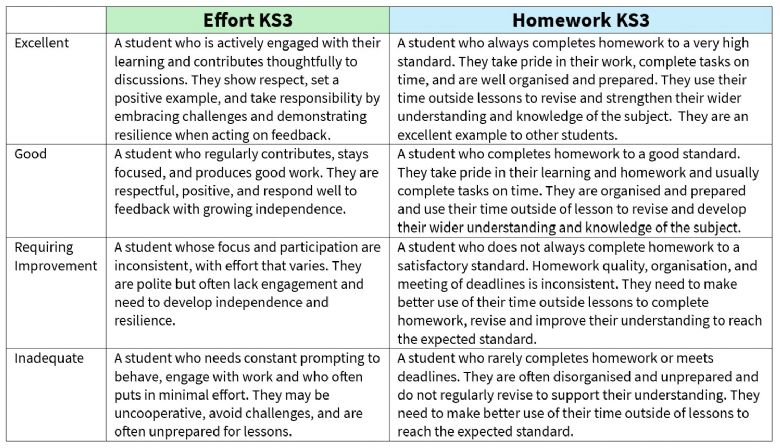
Subject descriptors
For students in Years 7, 8 and 9, academic attainment is reported using subject descriptors. These descriptors explain what students are expected to know, understand and be able to do in each subject area.
The descriptors are aligned to four different most likely grade attainment bands:
- Emerging – broadly aligned to a Grade 1 at GCSE
- Developing – broadly aligned to Grades 2–3 at GSCE
- Meeting – broadly aligned to Grades 4–6 at GCSE
- Exceeding – broadly aligned to Grades 7–9 at GCSE
Copies of the subject descriptors for all Key Stage 3 subjects can be accessed via the links at the bottom of this page.
Progress Tests
As part of our commitment to supporting every student to achieve their full potential, all students in Years 7 to 9 will complete Progress Tests in English and Maths.
These are GL Assessment Progress Tests, which are online assessments used in schools across the UK. They help teachers understand how well students are progressing in these core subjects.
The tests:
- Measure progress and attainment in English and Maths
- Compare a student’s performance with the national average
- Help identify strengths, areas for improvement, and any learning gaps
The results are based on comparisons with a large national sample of students and give teachers valuable insight into each child’s progress over time.
These tests are not high-stakes exams and students do not need to revise for them. Instead, they are used to support teaching and learning in the classroom and to ensure students receive the right level of challenge and support.
Progress Test in Maths (PTM)
The Progress Test in Maths is an age-appropriate assessment used each year to check that students are developing well in mathematics.
The test looks at:
- Mathematical knowledge and understanding
- Key skills such as fluency, reasoning, and problem-solving
These tests help teachers understand how well students are progressing and identify any areas where extra support or challenge may be needed.
Progress Test in English (PTE)
The Progress Test in English is an age-appropriate assessment used each year to monitor students’ progress in English. It focuses on both technical skills and understanding of what students read.
The test has two parts:
- English Skills – spelling, punctuation, and grammar
- Reading Comprehension – based on an age-appropriate fiction text and a linked information (non-fiction) text
Together, these assessments help teachers track progress and support students in developing strong literacy skills.
Parents receive reports detailing their child’s progress and attainment, often featuring a Standardised Age Score (SAS) (where 100 is the average). This helps indicate if a child is performing in line with, above, or below national expectations for their age.
Cognitive Abilities Tests (CATs)
Students in all year groups have also completed Cognitive Abilities Tests (CATs). These tests help us understand how students learn, rather than what they have been taught. The tests are age-appropriate and are designed to give a broader picture of a child’s thinking and learning skills.
CATs look at four main areas:
- Verbal reasoning – understanding and using language
- Quantitative reasoning – working with numbers and numerical patterns
- Non-verbal reasoning – identifying patterns and relationships using shapes and diagrams
- Spatial reasoning – visualising and manipulating shapes in space
The results help teachers identify students’ strengths and any areas where extra support or additional challenge may be helpful. This allows teaching to be better matched to each child’s needs across all subjects.
Parents receive a report showing their child’s results, including a Standardised Age Score (SAS), where 100 represents the national average. This helps indicate whether a child is working in line with, above, or below expectations for their age.