The Curriculum
Our core purpose is to prepare students for the next steps in their lives and equip them with the skills, qualifications and knowledge to become high-achieving, well-rounded individuals, thus enabling them to reach their potential and achieve their aspirations and goals.
Our curriculum, both within and beyond the classroom, is designed to provide a high level of challenge in order to motivate students to find their unique strengths. Students have a range of rich and engaging educational experiences which positively impact on their aspirations and future pathways. The term ‘educational’ is used in the broadest sense and is about developing confident young people ready to take on the world!
Curriculum Philosophy:
- is broad, balanced, inspiring and inclusive and gives students access to a range of pathways both vocational and academic,
- promotes student wellbeing,
- builds confidence, resilience and independent working skills,
- encourages students to develop the skills, knowledge and understanding required to succeed academically,
- encourages students to participate in a wide variety of activities,
- places creativity and imagination at the heart of learning to develop enquiring minds,
- enables students to understand the connections and links between different subjects,
- raises students’ aspirations through promoting academic excellence,
- develops students' social and cultural knowledge, skills and understanding,
- develops students’ respect for spiritual and moral values, and tolerance towards other races, religions and ways of life,
- gives students the opportunities to put theoretical skills into practice and expand their knowledge beyond the exam specification,
- prepares students for the world of work in a rapidly changing world,
- gives students opportunities to extend their learning beyond the classroom through a wide range of extra-curricular activities,
The impact of our curriculum is measured in broadest sense - mental health, physical health, attendance, first-generation university students etc.
Curriculum Organisation
The curriculum outlines the key knowledge which students need to learn over their time at the Academy in order to be successful; this will then drive what and how we teach students as well as how we assess their learning. A knowledge rich, challenging curriculum that will require students to think deeply about subject and lesson content. In other words, the level of challenge in the curriculum sets the bar for the level of challenge in our classrooms.

This is a period of great change in education, we review our curriculum annually to ensure that it best meets the needs of learners.
Religious Education and PSHCE *
PSHCE, RE and Personal Development
A comprehensive programme of study promotes students’ personal development and enhances their spiritual, moral, social and cultural understanding. We prepare students for life in modern Britain and make sure they understand the fundamental British values of democracy, the rule of law, individual liberty, and mutual respect and tolerance of those with different faiths and beliefs. They learn about diversity, equality and respect across all parts of society. Students receive age-appropriate relationships, sex and health education (RSHE), in line with the Department for Education’s statutory guidance (July 2025). They learn about healthy, respectful relationships, staying safe online and offline, and the importance of looking after their physical and mental wellbeing. Students are also taught about careers and the world of work, preparing them for future success in education, employment or training. We support and encourage all our students to be confident, responsible and respectful individuals.
How PSHCE* and RE are taught
Students in Years 7 to 9 have a weekly 50-minute PSHCE lesson with a consistent teacher who knows them well. Students in Years 10 to 13 are taught PSHCE by their Form Tutor across two sessions each week. RSHE is also taught through science, RE, PE, food and computing, and through assemblies.Religious Education (RE) is taught as a standalone subject in Years 7 and 8. In Years 9 to 13 it is taught as part of the PSHCE programme. Students explore a range of religions and worldviews, helping them understand and respect the beliefs of others and reflect on their own.
Working with parents and carers
Parents and carers receive a half-termly PSHCE newsletter for their child’s year group. It sets out what is being taught, suggests questions to talk about at home, and signposts further support. Our RSHE policy and RSHE Curriculum Map are available below. You can find details of your right to request that your child is withdrawn from sex education in the policy. If you would like to view any of the materials we use, or have any questions, please contact Mrs Mandy Stocks, Senior Assistant Principal.*Personal, Social, Health and Careers Education
Enrichment
Our extensive enrichment curriculum enables students to broaden their cultural understanding of the world, learn new skills and take on personal challenges. Alongside our PSHCE lessons which are delivered twice weekly in form time, and PSHCE lessons in Years 7 and 8, students also have access to a wide range of clubs and activities at lunch and after-school for example:
- The Fandom Zone
- Art Club
- Lunchtime Homework Club
- School Production
- Young Voices
- Dance Club
- Keyboard Skills
- Climbing Wall
- Netball
In addition, the school runs an enrichment afternoon each week where students can select from an amazing range of varied and different activities that change regularly. Here are some examples
- Ancient History
- Book club
- Baking / Bake off
- Cadets
- Climbing Wall
- Creative Arts
- Cross Fit
- Dance
- Drama Club
- Dungeons and dragons
- Escape rooms
- Forest Schools
- German for all
- Musical Mindfulness
- Netball
- Rugby
- Seasonal crafts
- Young Voices
Our aim is to develop young people who are responsible, resilient, thoughtful and aware of the world around them. The enrichment curriculum is designed to prepare them for life in modern Britain and equip them with the spiritual, moral, social and cultural skills to be respectful, tolerant, caring citizens.
Access to the Curriculum
We believe that all learners are of equal value, and that every student should have equal access to the high-quality education we provide. To achieve this, we are proactive in ensuring that our education meets the needs of all students and complies with the Equality Act 2010 and the Special Educational Needs and Disability Regulations 2014. We provide a range of support and also make reasonable adjustments where necessary to ensure that no student is at a disadvantage to their peers.
Key Stage 3
Students in Years 7–9 follow a broad curriculum designed to build upon and extend the knowledge and skills developed at primary school.
Our experience of teaching the Mastery Pathway has enabled us to take the best elements of the mastery approach—such as identifying learning gaps and ensuring students consolidate knowledge, skills, and understanding before moving on—and adapt them to suit our context.
Expressive Arts (Music, Dance, Drama, and Art) are taught as discrete subjects in Years 7 and 8. In Year 9, these subjects are delivered on a half-yearly rotation.
Key Stage 4
In year 10, we seek to personalise the curriculum to enable all students to pursue their strengths, interests, and career aspirations. Students will typically study three options, alongside the core subjects. We offer a wide range of subjects such as photography, psychology, sociology, enterprise and engineering to name only a few!
For students who would benefit from a more personalised approach, we also offer a Foundation Learning Pathway which offers smaller group support and a more tailored options programme. In the lead up to selecting their options, students and parents/careers receive extensive information, advice, and guidance to enable them to make the right choice. This includes careers work in PSHCE (Personal, Social, Health and Careers Education) lessons and an options evening which allows all students and parents to meet with subject teachers.
A full list of all the Key Stage 4 courses we offer is available in the KS4 options booklet which is available in the "Guided Options" section.
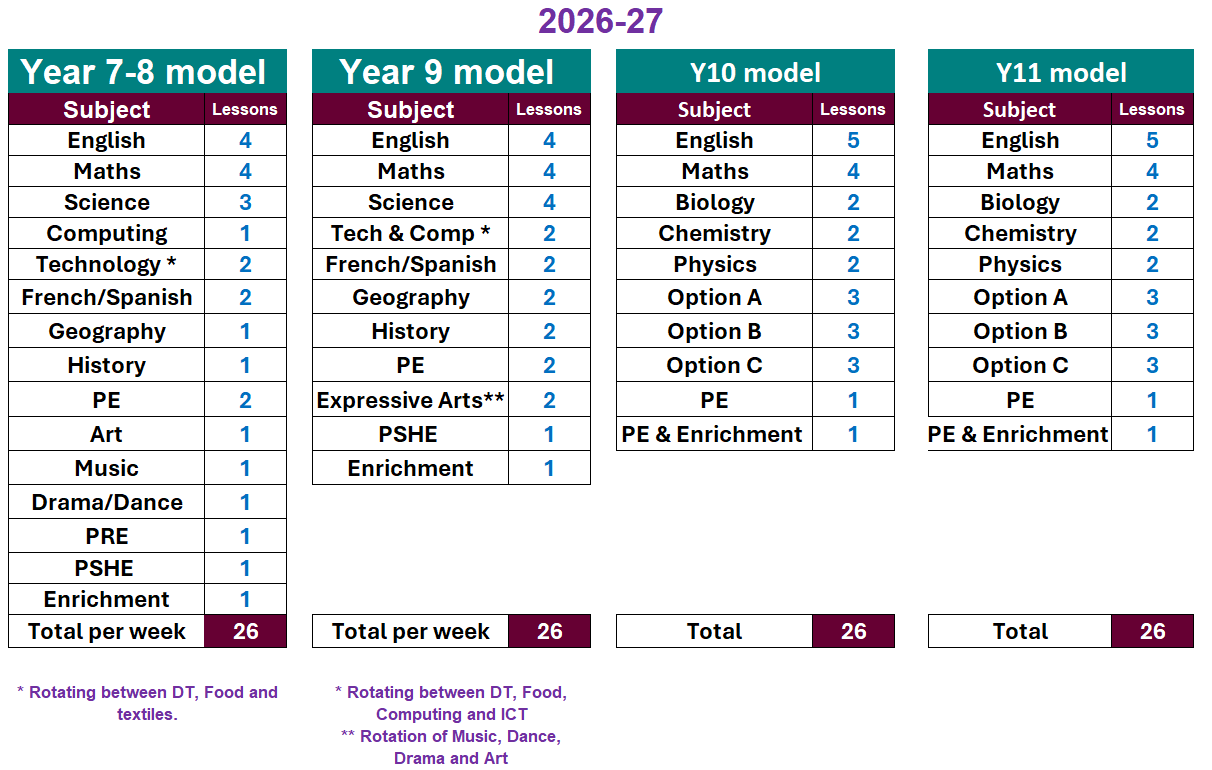
Curriculum Allocations
We operate a one-week timetable with the subject allocations for students being broken down as follows:
Key Stage 5
The majority of Year 11 students stay with us beyond GCSE and join our on-site sixth form with an increasing number of external students choosing us as first choice.
Our programmes of study are predominantly A Levels although more recently we have been able to offer an increasing selection of applied courses enabling students more flexible pathways. All qualifications are taught on-site by specialist subject teachers.
The courses we offer have been carefully selected to reflect students' prior attainment and strengths as well as their personal education and career aspirations. Combined with bespoke careers advice, weekly personal development sessions, work experience in Year 12 and weekly enrichment opportunities we focus heavily on ensuring all students have some form of progression into the next stage in their lives.
Students who do not achieve GCSE Grade 4+ in English and/or Maths have resit lessons built into their study programme.
Additional information on our sixth form provision is available via the Sixth Form tab above.
A full list of all the Key Stage 5 courses we offer can be found in the course directory.
Curriculum Maps - info for parents
Detailed information on specific subjects KS3-5 Curriculum is available via the below links. Additional curriculum information including careers, homework and options choices can be found under the students tab above.
If you would like any additional information on the curriculum, please email Mrs Ward, Assistant Principal (Curriculum) via wardk@elizabethan.notts.sch.uk